-1.svg)
Blog
Should You Replace IVR With Conversational AI?
15 May 2026
The problem with IVR payment journeys
Traditional IVR payment journeys remain effective for simple, high-volume transactions, but they often struggle when callers need reassurance, flexibility, or support before completing a payment. Conversational AI can improve these journeys by handling intent and context, while secure IVR payment flows continue to protect card data and compliance.
Most IVR payment systems were built for consistency, not flexibility. They follow predefined paths, rely on structured inputs, and expect callers to adapt to the system. This approach remains highly effective for simple, predictable interactions and high-volume environments.
However, as customer expectations have evolved, these same journeys can create friction in more complex scenarios. Callers may hesitate, repeat themselves, or abandon the process altogether. Each failed interaction adds time, increases cost, and shifts more demand to live agents. At scale, even small inefficiencies have a measurable impact on operational performance.
The gap between how customers want to interact and how some IVR systems respond continues to widen, particularly where flexibility and understanding are required.
What customers are trying to solve
Across finance, utilities, telecoms, and retail, our customers are asking similar questions:
- Do we need to replace IVR, or can we improve what we already have?
- How can we modernise payment journeys without increasing risk?
- Where can we reduce friction for callers while improving containment?
- How do we maintain strong security and compliance standards?
- What is the right way to introduce AI without disrupting operations?
These are practical concerns. The goal is to improve outcomes for both customers and the business while protecting existing investments and choosing the right approach for each use case.
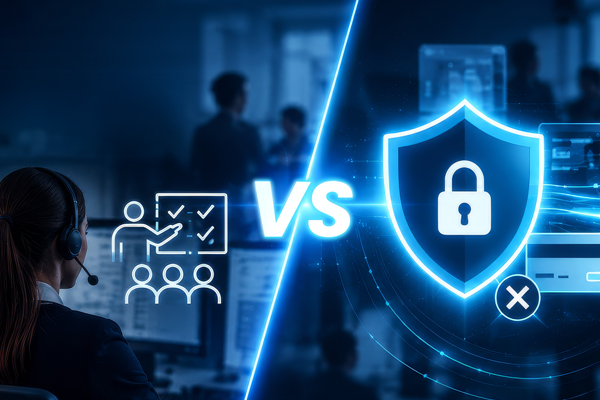
Conversational AI Agents vs Traditional IVR
A traditional IVR relies on DTMF tones or basic speech recognition to guide users through fixed menus. It performs well when journeys are simple, structured, and predictable.
An AI agent introduces natural language understanding. Often referred to as Agentic AI, these systems can interpret intent, manage more complex conversations, and take action in real time. This creates a more fluid interaction, particularly when callers move outside expected paths.
A hybrid model combines both approaches. AI handles the conversational layer, while traditional IVR flows continue to support specific functions such as secure payment capture. This allows organisations to optimise existing investments while introducing more advanced capabilities where they deliver the most value.
Compare the options
Traditional IVR
Best for: Simple, menu-based tasks and secure phone payments.
Why use it: Reliable, predictable, and easy to control.
Payment role: Captures card details through secure keypad entry.
Compliance role: Helps keep sensitive payment data away from agents and recordings.
Conversation AI
Conversational AI Agents
Best for: Customers who need help, have questions, or do not fit a simple menu flow.
Why use it: Creates a faster, more natural self-service experience.
Payment role: Explains balances, payment options, and next steps before routing to a secure payment workflow.
Compliance role: Needs guardrails for privacy, accuracy, data handling, and escalation.
Hybrid AI + IVR
Hybrid Conversational AI + IVR
Best for: Organizations that want a better customer experience without weakening payment controls.
Why use it: AI manages the conversation; IVR manages the sensitive payment step.
Payment role: Guides the customer to payment, then transfers them to a secure payment capture flow.
Compliance role: Keeps sensitive payment data in a controlled environment while still improving customer experience.
For a closer look at how this can be applied, explore our Conversational AI Agent solution.
Why payment journeys are a strong use case
Payment interactions are structured by nature. Customers call with a clear objective, whether that is to settle a bill, make a partial payment, or update their details. This clarity makes payments well suited to both IVR and AI-led journeys.
At the same time, payment calls often include moments of uncertainty. Customers may ask questions about balances, request payment options, or need reassurance before completing a transaction. These are the points where more conversational approaches can add value.
AI agents can manage both the structured and conversational elements of these interactions, while IVR continues to provide a secure and reliable framework for payment capture. This makes payment journeys an effective starting point for organisations looking to optimise or evolve their contact centre strategy.
If you are looking to take payments with a traditional IVR system, see our Self-Service IVR Payments page.
The benefits of merging IVR payments into an AI agent
Better language handling
AI agents understand natural speech patterns, accents, and variations in phrasing, allowing callers to interact more naturally while improving accuracy.
Lower friction
Reducing reliance on rigid menus shortens the path to payment. Callers can state their intent and move directly to the next step, improving completion rates.
Improved containment
AI agents can handle a broader range of queries within a single interaction, while IVR continues to manage secure, structured processes efficiently.
Smarter routing and escalation
When escalation is required, AI provides context such as intent, history, and key data, helping agents resolve issues faster.
A modern user experience
AI-driven journeys align more closely with how people communicate, while IVR ensures consistency and reliability where needed.
To understand how secure payment handling supports these outcomes, visit our Secure Voice Payments solution.
Security and compliance considerations for payment journeys
Security remains central to any payment interaction. Whether using IVR, AI, or a hybrid approach, strong compliance controls are essential.
Sensitive payment data must be captured and processed within secure environments. Techniques such as tokenisation, pause and resume, and data isolation continue to play a critical role.
Standards such as PCI DSS remain essential, and any solution must support these requirements while maintaining a seamless customer experience.
For definitions of key terms used throughout this blog, see our glossary.
A practical migration path
Where to start
Focus on high-volume payment journeys where friction or drop-off is most visible. These areas provide clear opportunities to improve both experience and efficiency.
What to keep
Retain components that already deliver value, including secure payment capture, compliance frameworks, and core integrations.
What to change
Introduce AI at the front of the journey where it can enhance interaction quality, while maintaining IVR for structured processes. Expand its role over time as performance data builds confidence.
This phased approach allows organisations to adopt new capabilities while maintaining stability and control.
Modern payment journeys do not require a single approach. Both traditional IVR and AI-driven agents have a role to play, depending on the needs of the organisation and the expectations of its customers.
IVR remains a reliable and effective option for structured, high-volume transactions where consistency, security, and predictability are key. At the same time, Agentic AI introduces a more flexible, conversational layer that can reduce friction, handle variation, and adapt to more complex interactions.
Many organisations are now choosing to deploy one or both approaches in combination. This allows them to optimise performance in the short term while evolving towards more advanced, AI-led experiences over time.
Whether you are looking to enhance an existing IVR payment journey, introduce Agentic AI, or design a hybrid model, the right approach will depend on your operational goals, customer needs, and compliance requirements.
If you are evaluating how to evolve your payment journeys, speak to us today about IVR, Agentic AI, or a combination of both, and secure payments across every channel.
FAQs
Will AI replace our existing IVR completely?
Not just yet. Most organizations adopt a hybrid approach at the start of their AI transformation. AI enhances existing IVR rather than replacing it entirely.
How does AI improve payment journeys specifically?
AI reduces friction, improves understanding of caller intent, and increases containment while maintaining secure payment handling.
What happens if the AI cannot handle a request?
The interaction is routed to an agent with full context, which ensures continuity and reduces repetition.
How do we maintain compliance with AI in place?
AI operates within established secure payment environments and must meet the same compliance standards, including PCI DSS.
What does a typical rollout look like?
Organizations usually begin with targeted payment use cases, then expand based on performance and business impact.